
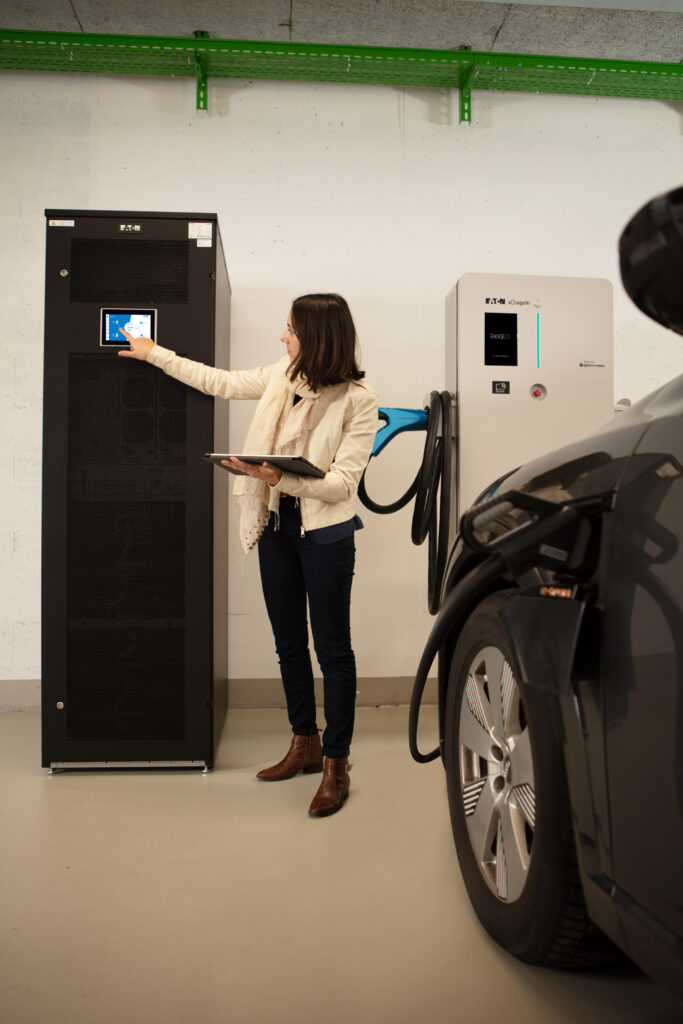
Transforming buildings into energy hubs
Power management company Eaton is launching a comprehensive suite of hardware, software and services that can transform buildings into energy hubs that extract maximum benefit from on-site renewable generation. Its ‘Buildings as a Grid’ approach to energy transition and electric vehicle charging has been enhanced following the recent acquisition of Switzerland based Green Motion SA, a leading designer and manufacturer of electric vehicle charging hardware and related software.
Eaton has taken an ‘Everything as a Grid’ approach to the energy transition to help customers accelerate decarbonisation, boost resilience, reduce energy costs and create new revenue streams. For building owners, by managing the building energy system as a grid, Eaton can transform facilities into energy hubs that better manage existing electrical infrastructure and plan for future energy needs.
Eaton’s Buildings as a Grid approach constitutes the most comprehensive and integrated energy transition offer for building owners and comprises three systems: EV charging, energy management and power distribution. Together these systems allow building owners to monitor and optimize the energy performance of their building and securely control energy assets. This is what the three systems do:
- EV charging system:this is grid-connected EV charging hardware and software that provides a high level of service for EV charging users, as well as supporting dynamic charging and pricing;
- Energy management system: this improves the resilience of a building’s electrical infrastructure and supports growing requirements for EV charging capacity in the building by providing demand-side flexibility. This is achieved with energy management software that manages energy flows amongst flexible energy assets that could include: EV chargers, energy storage systems, solar inverters and physical controls for heat pumps and boilers.
- Power distribution system: manages electrical power distribution and protection.
The combination of energy storage and energy management software offers multiple benefits: it can be added without the costly civil engineering works often associated with grid upgrades and it allows users to store off-peak energy and any self-generated renewable power they can make available from sources such as on-site solar photovoltaic (PV) generation. Stored low-cost power can be used at times of expensive peak demand, saving money and benefitting the environment because it enables what’s known as ‘peak shaving’ – reducing the load on the grid to prevent it being switched to carbon-intensive fossil fuel power which may be all that is available when demand is at its heaviest.
The energy management software is the ‘glue’ of the system from power generation sources to EV charging and buildings loads or energy storage. It helps building owners to monitor the energy performance of their buildings and securely control energy assets according to financial or business-driven needs and objectives and sustainability goals.

