
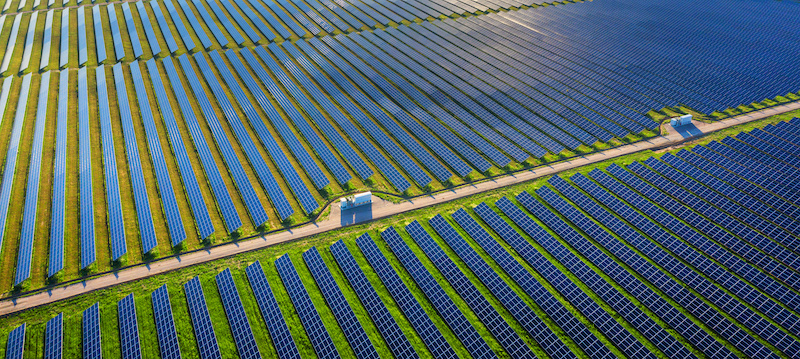
Solar PV will dominate the global energy mix by the middle of this century, study predicts
New research suggests the world may have reached a “tipping point” where solar power will become the dominant energy source before 2050, even without more ambitious climate policies.
The study, led by the University of Exeter and University College London, used data-driven models showing how solar PV costs are rapidly declining through technology innovation and economies of scale. It predicts solar will surpass other power sources globally by mid-century.
However, it warns four barriers could hamper this: creation of stable power grids, financing solar in developing economies, capacity of supply chains, and political resistance from regions that lose jobs. The researchers conclude it may be more effective to implement targeted policies addressing these four obstacles, rather than relying solely on carbon pricing schemes.
They advise governments focus efforts on building resilient grids, expanding solar finance mechanisms in poorer nations, ensuring adequate supplies of solar materials, and managing impacts on workers in declining fossil fuel industries.
Dr Femke Nijsse from Exeter’s Global Systems Institute said:
“The recent progress of renewables means that fossil fuel-dominated projections are no longer realistic. In other words, we have avoided the ‘business as usual’ scenario for the power sector. However, older projections often rely on models that see innovation as something happening outside of the economy. In reality, there is a virtuous cycle between technologies being deployed and companies learning to do so more cheaply.
“When you include this cycle in projections, you can represent the rapid growth of solar in the past decade and into the future. Traditional models also tend to assume the ‘end of learning’ at some point in the near future – when in fact we are still seeing very rapid innovation in solar technology. Using three models that track positive feedbacks, we project that solar PV will dominate the global energy mix by the middle of this century.”
The paper was published in the journal Nature Communications: “The momentum of the solar energy transition.”

