
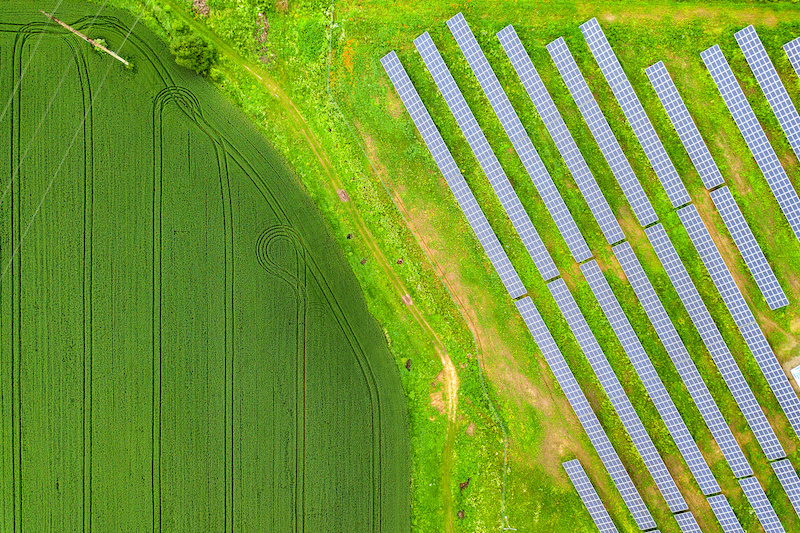
Government to expand powers to block solar projects on British farmland
New reporting from the Guardian says prime minister Rishi Sunak and Environment Secretary Thérèse Coffey are planning to impose new restrictions this year on the installation of solar panels on large areas of British farmland.
It is believed the plans are being driven by some rural Conservative MPs who dislike the visual impact of solar arrays in the countryside.
The proposal to limit solar farm expansion is a revival of an unpopular policy briefly promoted, and subsequently dropped, by former PM Liz Truss.
The new solar farm restrictions would be enacted by granting planning officials enhanced powers under the National Planning Policy Framework (NPPF) to reject any project deemed to potentially “put food security at risk”. Greg Smith, MP for Buckingham and an outspoke solar opponent, drafted the language in the NPPF granting these extended powers.
Climate groups have warned such open-ended criteria could enable planners to arbitrarily block solar projects and amount to a de facto ban on solar farms on agricultural land. They argue this ignores how solar arrays can be compatibly integrated into farms through agrivoltaic systems.
Analysis from the Energy and Climate Intelligence Unit predicts solar restrictions could cost UK ratepayers up to £5 billion annually in higher energy bills – over £180 per household. This would also hamper the UK’s transition away from expensive fossil fuels.
The solar proposal represents the latest weakening of the UK’s climate change policies under the current government. Recent decisions to push back the petrol/diesel car phase-out target and water down home gas boiler phase-out requirements have already raised concerns.
The Guardian quotes critics of the solar ban:
Alethea Warrington, senior campaigner at climate charity Possible:
“It is mindblowing that as the UK faces yet another winter of unaffordable energy costs caused by reliance on dirty gas, the government would make it still more difficult to build the clean, cheap energy we desperately need.
“The idea that solar power could interfere with the UK’s food security is utterly detached from reality. Solar power generated over 8% of all our electricity this spring, but takes up less land than golf courses. This is part of an abysmal streak of energy policy from the government, including failing to properly unblock onshore wind, failing to get any new offshore wind, and trying to press ahead with incredibly dangerous new oil drilling.”
Lydia Collas, senior policy analyst at Green Alliance:
“Solar energy will help us move away from polluting fossil fuels, and in the long term protect UK farming from climate breakdown. Restricting ground-mounted solar would be gravely short-sighted. ”

