Flexibility tech could cut UK energy costs by £70bn
25 February 2026
New research suggests that achieving the UK government’s net zero targets at the lowest cost depends on widespread use of renewables, nuclear power and innovations that make the energy system more flexible.
A report from Energy Systems Catapult says scaling technologies that help balance electricity and heat demand could reduce total energy system costs by at least £70bn by 2050, compared with scenarios with lower levels of renewables and flexibility. The organisation says this could also create significant commercial opportunities for UK businesses developing flexibility technologies and services.
The modelling explores four future scenarios and finds that systems with rapid deployment of renewables supported by low-carbon flexibility have the lowest overall costs. Rising and more variable electricity demand makes such flexibility increasingly important. Electricity demand could rise by up to 80% by 2040 as electric vehicles, heat pumps and data centres expand, increasing the need to manage peaks in consumption.
The report argues that flexible solutions are needed across homes and businesses to store surplus energy and release it to the grid when demand is high. Technologies highlighted include electric vehicles, static batteries, heat storage, hydrogen storage and digital services that coordinate energy use across decentralised assets.
Guy Newey, chief executive of Energy Systems Catapult, says:
“Embracing flexibility could help the UK save billions in infrastructure costs – while giving homegrown innovators a platform to scale up and compete globally.”
The research suggests electric vehicles could provide particularly valuable flexibility if smart charging and vehicle-to-grid systems are widely adopted, although further innovation and integration with the wider energy system are needed. It also finds that nuclear and renewable generation can complement each other, with modelling indicating that excluding new nuclear capacity could increase system costs through additional gas and offshore wind deployment.
The modelling indicates households could provide around 76 gigawatts of electricity flexibility by 2040, along with more than 350 gigawatt-hours of thermal storage, while the commercial sector could provide about 8 gigawatts through technologies such as building management systems. Heat networks combined with thermal storage could also contribute significant flexibility.
Energy Systems Catapult says unlocking flexibility is an urgent priority to balance supply and demand in near real time and to help UK businesses capture growing domestic and international markets for flexibility technologies and services. The market for flexibility in Europe is expected to reach billions of euros annually by 2030.
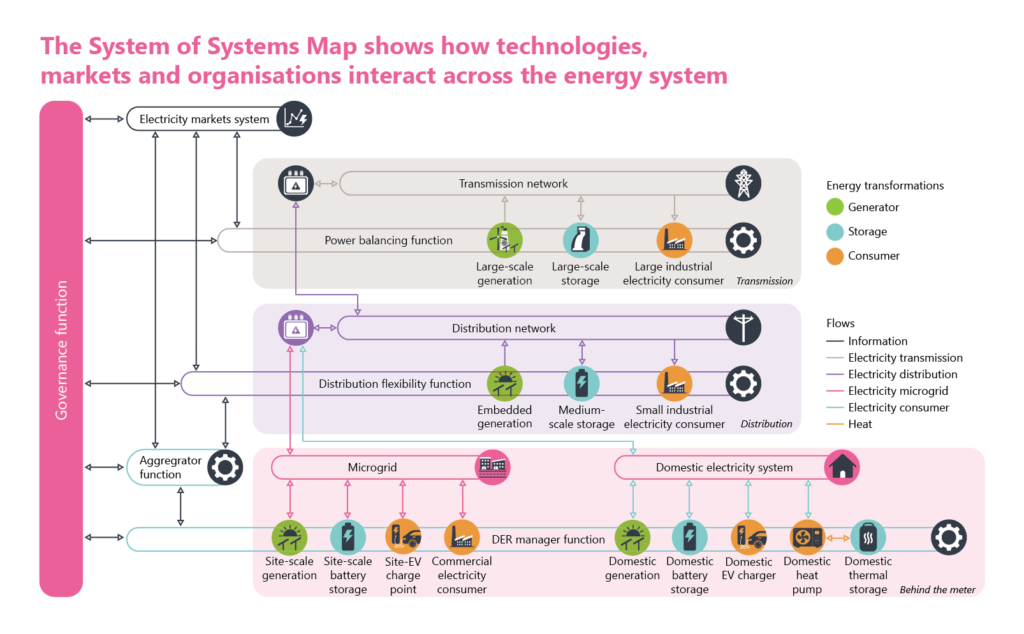
The organisation has published an interactive dashboard and a “System of Systems Map” to show how technologies, markets and organisations interact across the energy system. The map reflects a shift from a centrally controlled system dominated by large fossil-fuel power stations to a decentralised network coordinated by millions of flexible assets.
Jon Saltmarsh, CTO at Energy Systems Catapult, says:
“Our approach to balancing supply and demand needs to shift from centralised command of electricity generation to orchestrating flexibility from distributed, smart energy assets, such as EV chargers, static batteries and electric heating. This requires a shift in both mindset and approach and it provides fantastic opportunities for innovation.”
Read the report and access the interactive dashboard here.