

Energy efficiency policy is driving solar in new builds
The introduction of more stringent rules on energy efficiency for new homes in England has driven a surge in solar panel installations.
The proportion of new homes and buildings that come with solar photovoltaic panels included has risen by more than three times in the last twelve months.
Solar Energy UK estimates that 45,070 new-build homes were completed in England over the fourth quarter of last year, the latest for which figures are available. Figures from the Microgeneration Certification Scheme (MCS), the standards body for smaller-scale sustainable energy systems, say that 18,954 installations were made on newbuild properties over the same period. Assuming that all of these were on homes indicates that 42% of these new homes are solar-powered.
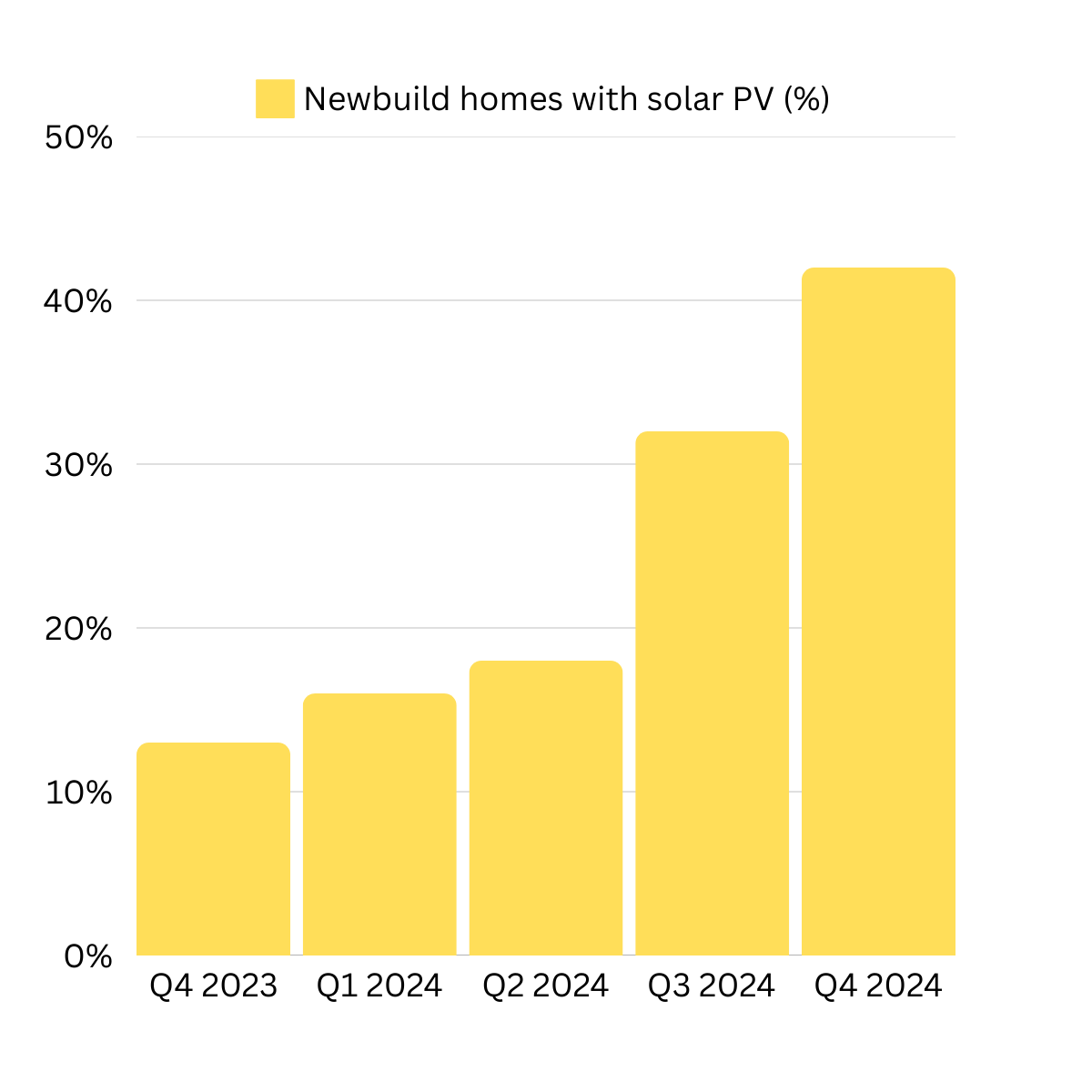
That is a dramatic jump compared to only 5,731 of 44,310 newbuilds sporting solar panels in the last quarter of 2023 – only 13%.
“It’s a reasonable assumption that at least 40% of new English homes now have solar power, given the clear trend in the data. It will certainly be a much higher proportion by the end of the year, when the transition to an upgraded energy efficiency requirement under the Building Regulations should be complete. Comparable rules in Scotland led to 80% of new homes having panels fitted,” comments Chris Hewett, chief executive of the trade association Solar Energy UK.
“There has been much attention lately on the next iteration of the Building Regulations, the Future Homes Standard, which we expect will all but mandate substantial solar installations on new homes. But is important to recognise how the existing rules are driving growth in the industry, while cutting emissions and bills for homeowners. The numbers demolish any suggestion that the solar industry would be unable to scale up to meet even greater demand under the forthcoming standard.”
The recent increase results from revised ‘Part L’ rules on residential energy efficiency, which have applied in full since June 2023. Although welcome, a consequent fall in the average size of systems is rather less so.
“Before the new rules, fitting solar power to new homes in England was driven by either local planning requirements or the preference of self-builders. Planning conditions were applied on a site-wide basis and tended to mean that solar installations were concentrated on a few homes, to comply in the most convenient and cost-effective way. In contrast, self-builders would ensure that their installation was of the right size to make a cost-effective contribution towards meeting their own energy requirements,” adds Stuart Elmes, chief executive of roof-integrated solar manufacturer Viridian Solar.
So, as the proportion of new homes with solar photovoltaic panels built by private developers has risen, average capacity for newbuilds has declined, going from about four kilowatts at the end of 2023 to only 2.4kW in Q4 this year.
Meanwhile, the number of solar retrofits to existing homes has hovered around 8,000 to 10,000 each month in England for more than a year. Driven by a combination of high energy prices, low installation costs and environmental concerns, the number remains far greater than before the energy price crisis.
Both newbuild and retrofit aspects of the market have driven the number of rooftops with smaller-scale solar installations across the UK to over 1.6m – over 180,000 in 2024 alone. For England, the figure stands at 1.3m, 169,000 of them coming since January 2024.

