When reliability is top priority
Maintaining process heat is crucial for many sectors. Hans Bahnsen discusses why having a reliable, efficient boiler is essential for your manufacturing plant
When we think of boilers we understandably think of heat and how boiler technology contributes to keeping us warm. However, in industry, boilers can have other important uses, which aren’t necessarily related to providing heat and hot water to buildings.
One such application is process heat. This is where industrial-sized steam or hot water boilers, not dissimilar to the ones you see in district heating networks, are utilised in production lines within manufacturing plants and factories. It’s the application of heat for industrial processes.
Two obvious sector s are the food and beverage industries. However, some others not so obvious like a car manufacturer which may have a paint shop within their production line which requires hot air to fix the paint to the car. Boilers are used to generate that hot air through generating hot water and passing it through a heat exchanger. It is a similar process to heating a commercial building with a different end use.
So, with that in mind, boilers can be at the heart of any production facility that uses hot water or steam. So if the boiler shuts down the consequences can be catastrophic.
To emphasise the importance of the industrial boiler let’s look at the food and drink industry. Most industrial boiler applications are through generating steam, which is used as a means for transferring energy within a factory setting.
So, as an example, think of a dairy product company who pasteurises milk. When the factory opens the boilers are switched on and begin burning fuel to generate steam, creating a cycle of heat. This steam takes heat energy and transfers it to the area of the factory where the milk is pasteurised.
This is one part of the production process for the dairy company, but a critical one if this company has millions of bottles of milk leaving the factory door each day. Let’s say that its industrial boiler breaks down and stops working. This will halt the production line and could result in tens of thousands of pounds of lost revenue per every hour of boiler downtime.
This situation can of course be prevented however, if the right steps and options are made to begin with.
The simplest way of preventing boiler downtime is to have back-up also known as redundancy. Many manufacturers have more than one boiler installed, which is a very sensible system to have. If a boiler fails, or has a service, then another can be switched on to take its place and ensure the production line isn’t affected.
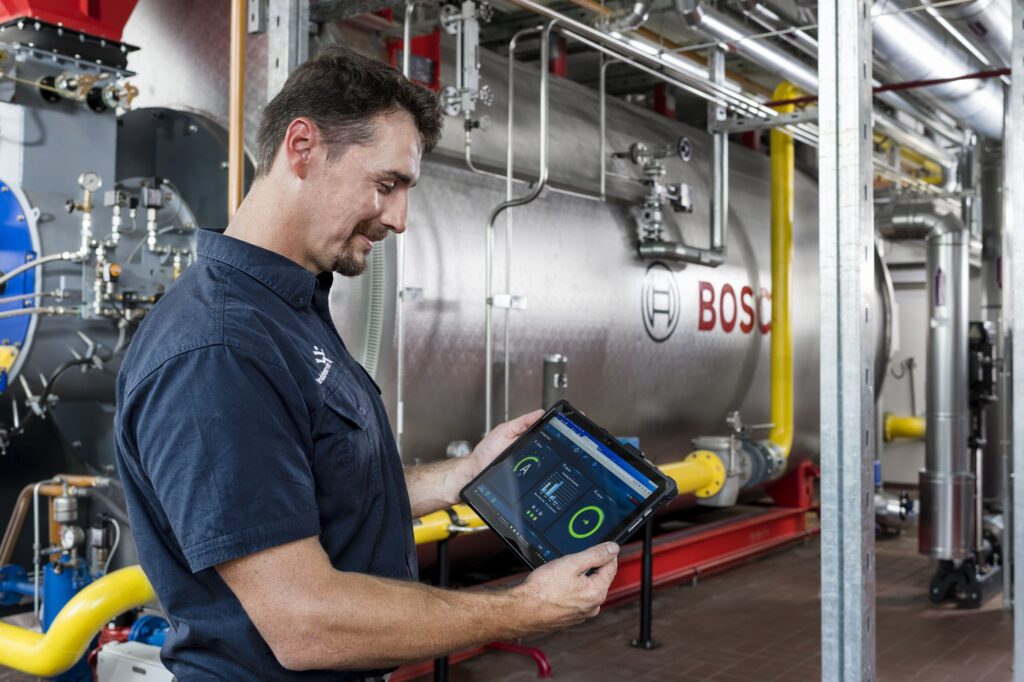
However, there are more robust and efficient ways to prevent possible failures thanks to the technological advances in controls. Through smart controls facility managers can monitor a system’s use, identify any issues and even pre-plan boiler servicing and downtime.
There are other benefits, like boiler efficiency levels. So far we’ve discussed the loss of revenue if a production line stops. However a faulty, old or leaking system can have an adverse effect on energy bills in the long term.
You can have the most efficient heating system from day one but what if nobody looks or monitors it in over a year? There may be issues that have cropped up during that time or the overall efficiency has reduced. By opting for boiler systems which have robust, smart monitoring technology it is possible to identify and resolve any possible efficiency issues.
Another area to be aware of is how future policies and technologies related to heating and processed heating will come to the fore. The UK has set an ambitious target of net zero carbon emissions by 2050 and there are many steps that need to be taken for that to become reality.
As industrial process heat is one of the biggest contributors to the UK’s carbon footprint, policy and regulations are already being put in place, which favour the use of alternative fuel to gas, such as hydrogen.
To stay ahead of that curve, manufacturing plants could opt for hydrogen or bio fuel-ready boiler systems which burn 100 per cent hydrogen (once the fuel becomes available on the gas grid). With only a simple change required, the boiler doesn’t need to be replaced later down the line saving on doubling up on initial purchase cost of a boiler system.
Finally, when searching for a new boiler for your factory opt for companies that offer bespoke services and products. No industrial boiler should be available ‘off-the-shelf’. Each and every manufacturing plant will have specific requirements so opt for a site visit where the boiler manufacturer can evaluate your needs, the space available and other technical points.
By taking the time to choose the best, most efficient boiler for the job will help save a lot of hassle down the line.
• Hans Bahnsen is UK & Ireland sales manager for industrial boilers for Bosch Commercial & Industrial