
Decarbonising hot water in hospitals
Reducing carbon emissions from hot water generation is one of the areas identified for achieving the NHS’ 2040 net zero target. Andy Green discusses the challenges and opportunities
Ensuring a reliable hot water supply is key as healthcare premises depend on water to create comfortable patient conditions and maintain the required clinical standards. However, hospital hot water distribution systems are highly complex. Consequently, measures need to be implemented to prevent the build-up of waterborne pathogens, mostly related to the control of legionella bacteria, in the hot water system. To reduce the risk of legionella1, the Health and Safety Executive (HSE) advises that domestic hot water (DHW) should be stored at least at 60ºC and distributed so that it reaches 55ºC at point of use in healthcare premises.
Associated with this is the need to avoid the risk of scalding and burns, particularly for the protection of vulnerable patients. Temperature control will therefore need to be provided at hot water outlets used by persons at risk of being scalded.
With a huge variety of building types and heating systems across the one estate, there can any number of possible solutions and the chosen route will depend on many factors. With that in mind, let’s consider some of the available opportunities to drive down emissions related to the hot water system while continuing to prioritise patient safety.
In buildings where a central boiler plant and calorifier provide both heating and domestic hot water (DHW), separating out the hot water is advisable to avoid unnecessary energy use. Having dedicated plant means that the chosen technology can be sized more closely to meet the specific requirements for each building. This makes more effective use of energy and opens up the ability to site direct electric or direct gas-fired hot water equipment at – or very close to – point of use.
Depending on where the hospital is in its sustainability plan, another option might be to upgrade any non-condensing direct-fired water heaters to more energy-efficient condensing models.
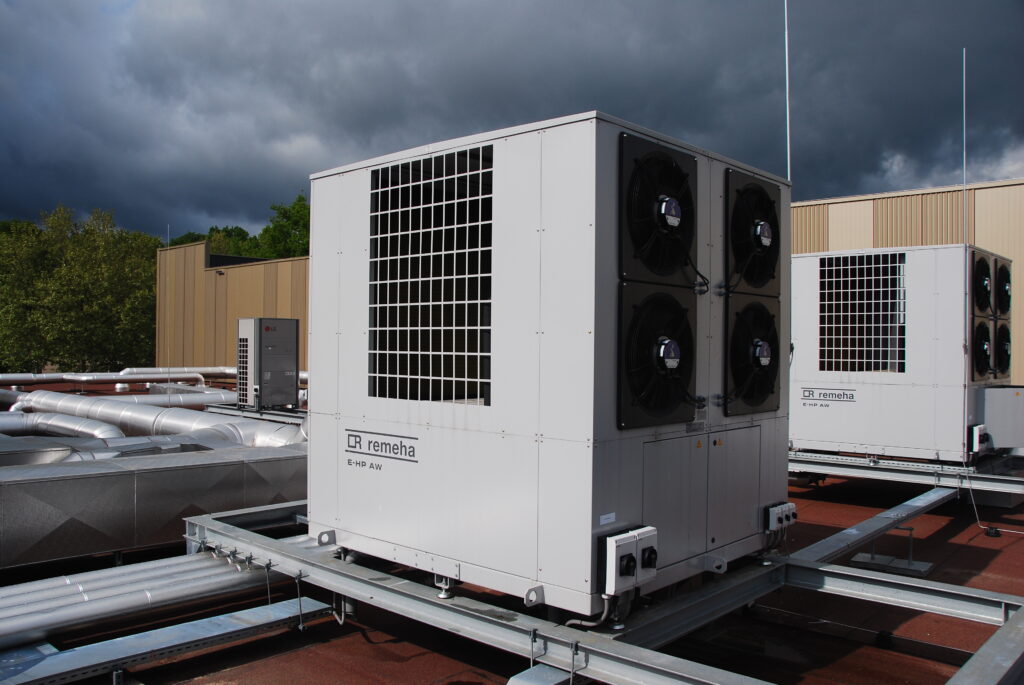
For the larger task of replacing the heating system, the favoured approach today will likely be to install heat pumps. When considering DHW generation, there is a number of ways in which ASHPs can be used.
Low-temperature ASHPs can be used with direct electric or direct gas-fired solutions to raise the DHW to safe temperatures. The direct electric approach is more likely to be the option of choice but would involve higher volumes of stored DHW – certainly compared with low-storage direct gas-fired water heaters which the building may previously have relied on.
If considering this solution, it’s important to consider available space and weight for the larger cylinders – particularly when dealing with rooftop or non-basement plant rooms. Controlling legionella within the larger volumes of stored water will also need to be carefully monitored and managed.
High temperature ASHPs are capable of delivering the high flow temperature required to meet the design temperature for sanitary hot water. The advantage of using HT heat pumps is that it avoids the need for an alternative form of technology to store the DHW above legionella temperatures (60ºC or higher). This makes it a truly low-to-zero carbon solution.
This option also offers greater design flexibility and requires less space, for a much simpler design and easier installation. However, it should be noted that the coefficiency of performance of heat pumps falls off at higher temperatures, affecting the real-world efficiency and subsequently operating costs.
In older NHS buildings, where the natural gas supply might be maintained, there is the opportunity to use ASHPs to preheat direct gas-fired water heaters (DGFWH).
Many DGFWHs are compatible with the projected 20 per cent hydrogen blend into the natural gas network. In time, the remaining gas use can be cut by using green hydrogen models, offering a practical opportunity for important immediate efficiency gains and emission reduction in older NHS buildings.
From a design perspective, DGFWHs have greatly reduced storage compared with other systems, which means less weight and fewer issues within roof top plant rooms. Importantly, energy usage is also reduced, along with associated emissions, as there is less water to maintain at temperature.
A further consideration is the use of point-of-use electric water heaters which only use energy when hot water is required. Installing a point-of-use water heater that incorporates anti-legionella functionality, water pasteurisation and anti-tamper design, will ensure that water is adequately stored, cycled and distributed.
Installation is the next consideration. Whether planning a complete or phased refurbishment, use of offsite fabrication will make it easier to ensure minimal disruption and continuity of the hot water service. Installation is faster and simpler, onsite time is reduced, and quality assurance is enhanced.
The options range from the largest externally sited containerised plant rooms to prefabricated modules for use in existing or containerised plant rooms that are purpose designed to provide a high-quality plug and play solution.
Putting a clear roadmap in place – identifying the overarching goals, the available time to complete the work, the budget and any funding opportunities – will make it easier to plan out and design the various stages of work, all the while prioritising a safe, reliable, and efficient hot water service.
Reference
1) https://www.hse.gov.uk/legionnaires/hot-and-cold.htm
• Andy Green is technical director at Baxi

