
Mancunians support ‘heat highway’ to bring excess industrial heat
1 July 2026
A new study by EnergiRaven suggests Greater Manchester could meet around 85% of its residential heating demand using excess heat from industry. Sources include data centres, power generation, water treatment plants, breweries, and food manufacturing facilities across the region.
The analysis estimates that capturing and distributing this waste heat via a district heat network could save approximately £8.83 billion over 20 years compared with continued reliance on gas heating and direct electric panel systems.
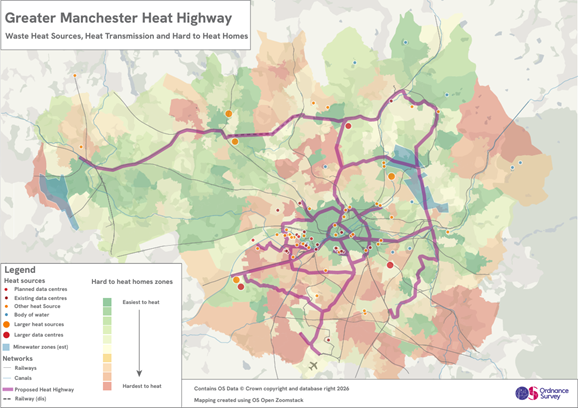
The proposal centres on a planned “Heat Highway” — a connected network of pipes designed to transport waste heat, store it as hot water, and distribute it to homes and buildings across Greater Manchester. The route has been mapped using detailed spatial datasets from the Ordnance Survey National Geographic Database, identifying both heat sources and high-demand residential areas.
Greater Manchester is seen as well suited for such a system due to its concentration of industrial sites, including major facilities such as Carrington Power Station and large-scale manufacturing plants like the Heinz site in Wigan. The region also includes legacy energy infrastructure and former mining areas identified as potentially suitable for geothermal heat recovery.
The city is also undergoing significant housing expansion, including large developments such as Victoria North, which is planned to deliver around 15,000 new homes. According to EnergiRaven, aligning new development with heat network infrastructure could reduce the need for individual building-level heating systems.
The report argues that heat networks could help address inefficiencies in current heating systems, particularly in high-rise buildings reliant on electric panel heating and in older, poorly insulated housing stock associated with fuel poverty. Different temperature levels could be supplied depending on building type, with higher temperatures for existing inefficient stock and lower temperatures for new builds.
Planners suggest the network could follow existing transport corridors such as railways and canals, reducing installation complexity while improving connectivity between industrial heat sources and deprived areas.
A survey commissioned by EnergiRaven indicates broad public support for heat networks, with around 70% of respondents in Manchester in favour, including majorities across multiple political groups. More than half also supported linking data centre approvals to requirements for heat reuse.
Simon Kerr, head of heat networks at EnergiRaven:
“There is enough excess energy to heat all the new homes that we are building in Manchester if we join the dots. Technically, there is no need to generate new heat in the city centre. The heat network could use what we already have.”

